


Articles on the Anthropocene
In-depth articles on the Anthropocene
When the bioeconomy loses its mind
From Georgescu‑Roegen to green growth, a chronicle of the decline of bioeconomic thought
Modern bioeconomy comes with lofty promises: doing business in harmony with nature, powered by innovation and new technologies. But is there a wolf lurking in the landscape?
‘Bioeconomy’: now there’s a word that really sells a dream! Presented today as ‘the economy of photosynthesis — and, more broadly, of living systems […] based on the production and mobilisation of biomass for optimal valorisation’, the bioeconomy is said to be ‘one of the long‑awaited answers to the environmental and societal challenges we currently face’, such as ‘reducing our dependence on fossil carbon while ensuring food and basic needs for 9 billion people by 2050’ [1, 2].
So, does the bioeconomy truly deliver on its promises of a bright future for all? Or is it about to join the graveyard of already overcrowded “ecological” pipe dreams, alongside the corpses of ‘green growth’, ‘sustainable development’, and the ‘ecological transition’? Against the grain of institutional panegyrics, this article offers a critical perspective on the bioeconomy. Spoiler: the reality is far less rosy than the advertising… though in a world ruled by spin doctors, we might have suspected as much.
At the Origin: A Conceptual Revolution
The history of the bioeconomy cannot be told without mentioning one of the most important thinkers (in my humble opinion) of the 20th century: Nicholas Georgescu‑Roegen, a Romanian‑born “heterodox” economist‑mathematician (read: too clear‑sighted to believe in the fairy tales of mainstream economics), best known for his major work The Entropy Law and the Economic Process, published in 1971 [3]. Although he did not coin the term “bioeconomy” (the Russian biologist T. I. Baranoff appears to have introduced the neologism as early as 1925), Georgescu‑Roegen is unquestionably a central figure of bioeconomic thought and one of its founding fathers.
Breaking with the “orthodox” vision (still dominant today), Georgescu‑Roegen viewed the economy as fully embedded within the biosphere and therefore entirely subject to the laws of nature. He introduced into economic theory the law of entropy (the second law of thermodynamics), according to which any transformation of a system is accompanied by an irreversible increase in entropy—that is, a degradation of its organization. Applied to the economy, this means that every economic activity consumes energy and resources, which are irreversibly degraded in the process.
For example, burning a lump of coal produces heat until the material is fully consumed. At the end of the process, the concentrated chemical energy stored in the coal has been transformed into thermal energy, dispersed into the environment. This energy, now scattered as disordered molecular motion, is far less available to perform useful work. The transformation thus results in a degradation of energy (from a concentrated, exploitable form to a diffuse, hardly usable one) and an irreversible increase in the system’s entropy.
Building on this premise, Georgescu‑Roegen concluded that in a finite world, the size of the economy must be constrained to a minimum in order to preserve resources and limit the rise of entropy. In other words, he advocated a path radically opposed to the one taken since the Industrial Revolution—one based on growth and an ever‑increasing consumption of resources. As early as the 1970s, he highlighted the particularly perilous nature of an economy built on the excessive use of resources, especially fossil ones. To escape this untenable “thermo‑industrial” system, he proposed a profound transformation of the economic process to establish a bioeconomy—an extremely frugal economy grounded in the use of resources directly derived from the sun, such as solar energy or biomass* (Figure 1).
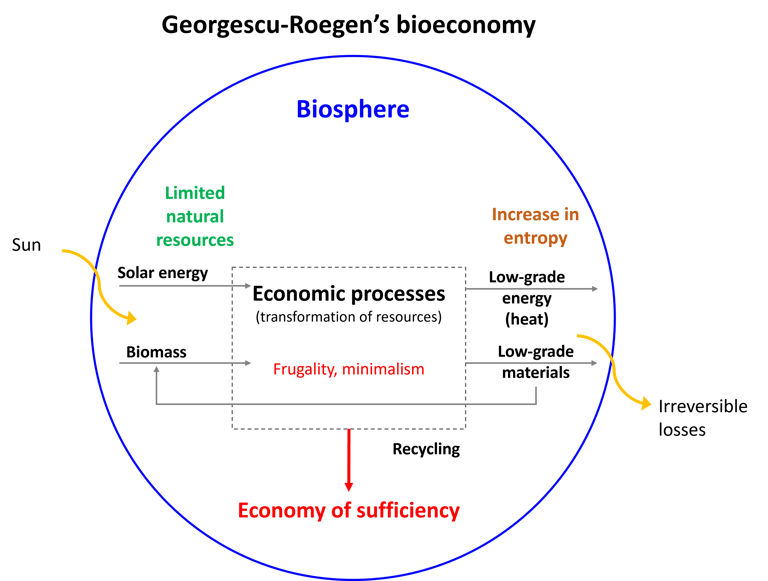
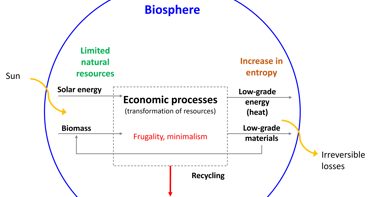
Figure 1: Conceptual diagram of Georgescu‑Roegen’s bioeconomy. Starting from the premise that any transformation of resources entails irreversible losses and an increase in entropy, this conception of the bioeconomy requires the use of resources directly derived from the sun (solar energy and the products of photosynthesis) within economic processes, all within a framework of extreme frugality aimed at establishing a sufficiency‑based economy.
In the end, Georgescu‑Roegen’s vision of the bioeconomy amounts to a genuine conceptual revolution, one that fundamentally overturns the foundations of ‘orthodox’ economics — for instance the classical and neoclassical schools. It is a vision in which the economy is embedded within the living world, subject to physical limits… and destined to comply with them, unless it chooses to drive straight into a wall.
Bioeconomy and degrowth: intertwined destinies
While Georgescu‑Roegen advocated the use of so‑called ‘renewable’ resources, he was crystal clear on one point: replacing fossil resources does not in itself guarantee a more sustainable system. Alongside the use of sunlight and the products of photosynthesis, it is therefore essential to exercise the utmost frugality in resource consumption. And we are not talking here about Emmanuel Macron‑style ‘sobriety’ or the techno‑optimist crowd [4], but about genuine minimalism aimed at building an economy of sufficiency—that is, an economy in which production is deliberately limited to what is enough, in the spirit of voluntary simplicity***.
Seen from this angle, the bioeconomy (‘an economy of frugality’) is clearly incompatible with the current model based on economic growth (‘an economy of inebriation’). Moreover, Georgescu‑Roegen rejected both infinite growth and ‘zero growth’ (or the ‘steady‑state economy’), because even without growth, resource degradation continues. The cornerstone of his bioeconomy is frugality, a principle that resonates with movements such as sobriété heureuse (Pierre Rabhi’s Towards Happy Sobriety), voluntary simplicity [5], or… degrowth [6].
Although he did not himself use the term ‘degrowth’, it is obvious that Georgescu‑Roegen exerted a major influence on the ideas championed by this movement, and he is often cited by its advocates as a spiritual father [7]. His bioeconomy is not just a theory, nor a business‑as‑usual scenario with solar panels on the roof and wind turbines in the garden: it is a radical critique of productivism and consumerism, an invitation to rethink our needs, our rhythms, and our relationship to the world—in short, a way of life and a comprehensive philosophy deeply embodied by degrowth proponents [8].
Bioeconomy, my friend, why have you betrayed me?
The birth of Nicholas Georgescu‑Roegen’s bioeconomy in the 1960s and 1970s ultimately found very little resonance among the ‘general public’ or within the economic sphere, as everyone cheerfully carried on acting as though the economy were a human world disconnected from nature—one that certainly required natural resources, but resources assumed to be inexhaustible and free, and therefore considered outside the scope of economic science****.
As the global degradation of the biosphere reached a scale that could no longer be ignored, it eventually exposed the pernicious nature of the thermo‑industrial system, which relies on the excessive use of natural resources and therefore entails a sharp rise in entropy*****. In the 2000s, the bioeconomy thus re‑emerged as an important concept in public debate.
But it has changed a great deal… Gone are entropy and frugality! Today, the term ‘bioeconomy’ refers exclusively to an economy based on the ‘optimal’ use of the products of photosynthesis and of living systems—that is, biomass (the material of living organisms: animals, plants, bacteria, fungi)—as opposed to (or rather, as we will see below, in addition to) the economy developed since the Industrial Revolution through the lavish use of necromass (the fossilised remains of dead organisms: oil, gas, and coal).
The bioeconomy has recently become the subject of a dedicated development strategy by the European Commission [9], which even set up a specialised observatory in 2014 [10]. This strategy lays out five priority objectives: (1) ensuring food and nutrition security; (2) managing the sustainability of natural resources; (3) reducing Europe’s dependence on fossil resources; (4) mitigating and adapting to climate change; and (5) strengthening Europe’s competitiveness and creating jobs.
‘Managing natural resources’, ‘boosting Europe’s competitiveness’, ‘creating jobs’… fair enough — but we are now very far indeed from Nicholas Georgescu‑Roegen’s economy of sufficiency!”
Following Europe’s lead, several countries have worked on developing a bioeconomic framework. France, for its part, adopted a national strategy for the emergence of the bioeconomy in 2017 [2], followed by an action plan in 2018 [11]. These strategic documents highlight notions such as short supply chains, circularity, and the optimization of the use of bio‑based resources.
One only has to read the French national strategy to grasp the extent to which the very notion of the bioeconomy has been distorted: ‘Innovative and green, [the bioeconomy] is a new way of looking at the economy while respecting the environment. […] It is based on the production and mobilisation of biomass for optimal valorisation. It makes it possible to make maximum use of an abundant, renewable and free source of energy: solar energy. […] It represents opportunities for our agricultural and forestry sectors, it helps increase the competitiveness of our industries while providing sustainable solutions to the environmental and societal challenges we face today. The bioeconomy is part of the broader framework of the green economy, that is, an economy that respects the environment and uses natural resources more efficiently.’ [2].
At least things are clear: the full repertoire of political‑ecology buzzwords is on display! The bioeconomy is ‘innovative’, driven by start‑ups and plugged into new technologies; it promises to deliver ‘green’ business by using supposedly ‘optimal’ and ‘efficient’ methods to exploit abundant and free resources (well, well — here comes the core assumption of orthodox economics sneaking back in through the keyhole), just waiting to be picked up off the ground.
Ultimately, the bioeconomy has been completely absorbed by ‘the system’, which has spat it back out as a kind of progressive mush stripped of its central pillar: the extreme frugality in resource use. And indeed, in these times of inebriation, applying such a principle of parsimony would require a massive reduction in material and energy flows — in other words, the dreaded economic degrowth that so terrifies progressives. Hence the omission of this inconvenient, yet absolutely crucial, dimension of Nicholas Georgescu‑Roegen’s bioeconomy…
The ‘original’ bioeconomy has not disappeared entirely, however, and a recent study identifies the coexistence of three major narratives of the bioeconomy [12]:
The ‘ecological bioeconomy’, broadly aligned with Nicholas Georgescu‑Roegen’s vision;
The ‘biotechnology bioeconomy’, largely grounded in innovation and the development of new technologies aimed at ‘mastering life’ and unlocking its full potential — a kind of new industrial revolution expected to generate new modes of production and consumption;
The ‘biorefinery bioeconomy’, which seeks to replace fossil resources with biomass within the economic process.
In practice, the major policies mentioned above freely blend the ‘biotechnology bioeconomy’ with the ‘biorefinery bioeconomy’: new technologies born of innovation are expected to deliver extraordinary possibilities for the optimized and efficient use of biomass, which can then replace fossil fuels within the economic system (Figure 2).
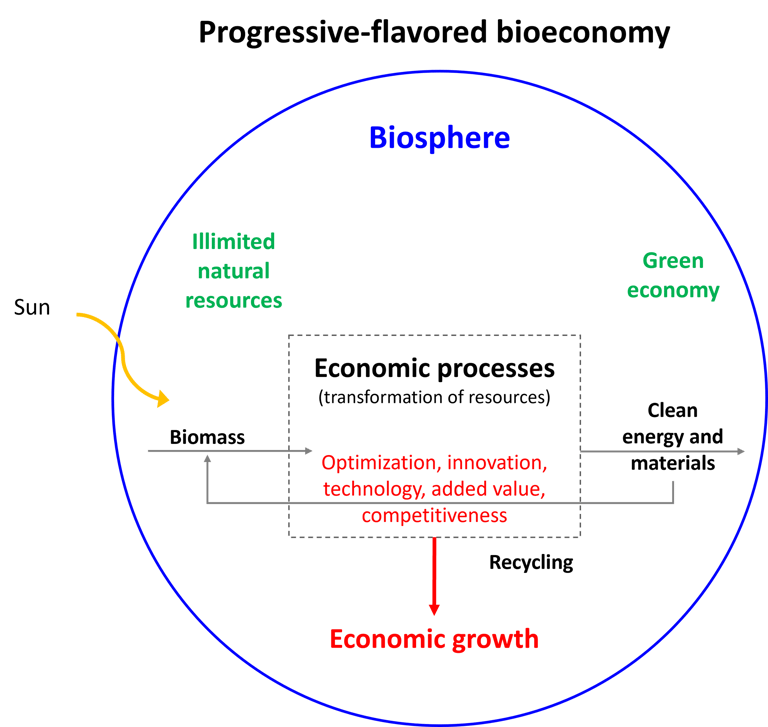
Figure 2: Conceptual diagram of the bioeconomy after its ingestion by progressivism. This vision of the bioeconomy assumes an ‘optimized’ use of biomass—treated as abundant, renewable, and free—within economic processes, relying on new technologies derived from innovation. These ‘innovative’ value chains aim to increase added value and competitiveness in order to support the ultimate objective of economic growth.
These two narratives of the bioeconomy are indeed perfectly compatible, because they are bound by a powerful common denominator: economic growth. The bioeconomy thus finds itself openly tied to ‘green growth’ [13], within a techno‑centred approach focused on innovation and new technologies—an approach in total contradiction with Nicholas Georgescu‑Roegen’s original conception (Table 1)!
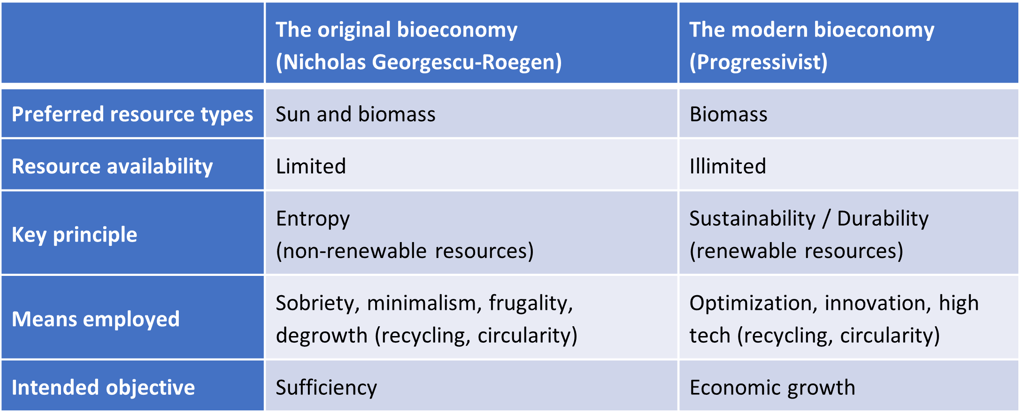
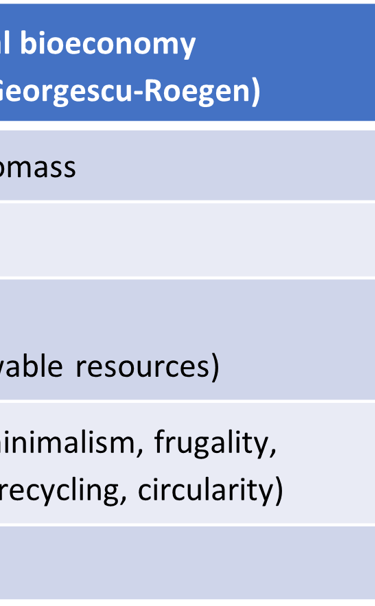
Table 1: Comparison of the main characteristics of the original bioeconomy and the modern bioeconomy; the modern bioeconomy has very little left in common with Nicholas Georgescu‑Roegen’s conception!
This accommodation of the bioeconomy, seasoned to taste with progressivism, reveals—beyond the remarkable ability of progressivists to appropriate any potentially subversive idea and bend it to their advantage—two things: (1) our obsession with innovation, technology, and growth, and (2) directly stemming from the first point, our inability to move beyond this model and imagine alternative possibilities.
But this brings us to the question raised by this ideological about‑face: once stripped of its central axiom in order to be folded into a context of economic growth, does such a bioeconomy still have any meaning at all, or does it become nothing more than an empty shell designed for communication purposes?
Bioeconomy and growth — is it actually possible?
Before discussing whether the bioeconomy can or cannot fit within a context of economic growth, it is worth stating an elementary truth—one that is often glossed over in contemporary discourse on the bioeconomy: in reality, the bioeconomy is anything but new, and for 99.99% of their history, humans have lived within a bioeconomic framework!
Throughout history, biomass has in fact been a fundamental source of materials and energy for human activity. Wood, for example, was already used in the Paleolithic for building shelters, accessories, tools, and weapons, and later became an energy source with the domestication of fire. The availability of wood is even thought to have been closely tied to the success or decline of civilizations [14]. In France, before the Industrial Revolution, wood was the primary energy source for domestic heating as well as for ‘proto‑industrial’ activities (glassmaking, forging, etc.), while transportation depended largely on renewable energy sources such as wind (ships) or animals (horses, donkeys, etc.).
What changed this? Fossil fuels, of course. From the 19th century onward, the industrial exploitation of coal—and later gas and oil—profoundly reshaped the economy. Many processes once powered by biomass came to rely on necromass instead: coal, gas, and oil took on an increasingly dominant role in domestic heating, industry, and transportation.
This perspective can easily feed the transition narrative: during the Industrial Revolution, fossil resources replaced biomass (the thermo‑industrial economy replaced the bioeconomy); therefore, all we need to do now is reverse the process by substituting fossil resources with biomass in order to return to a bioeconomic framework. This view is dramatically wrong for at least two reasons:
First, on a global scale, fossil fuels did not replace biomass at all — they were added to it. Coal, for example, did replace wood in a number of processes (metallurgy, domestic heating, etc.), but at the same time mines and ‘railways’ (which were also ‘woodways’!) required enormous quantities of timber [15]. Wood use therefore did not disappear with the arrival of coal: it simply changed. In reality, we have never consumed as much biomass as we do today. This is a crucial point: in a context of economic growth, resources are not substituted — they accumulate.
Second, contemporary discourse on the bioeconomy tends to forget a detail that is anything but trivial, and that is directly tied to this logic of accumulation: the extraordinary practicality and energy density of fossil fuels expanded the size of the economy at a speed and on a scale that are almost unimaginable, especially after the Second World War (the Great Acceleration). For example, global energy consumption increased roughly twenty‑five‑fold between 1850 and 2024, and thirty‑fold since 1800 (Figure 3) [16]!
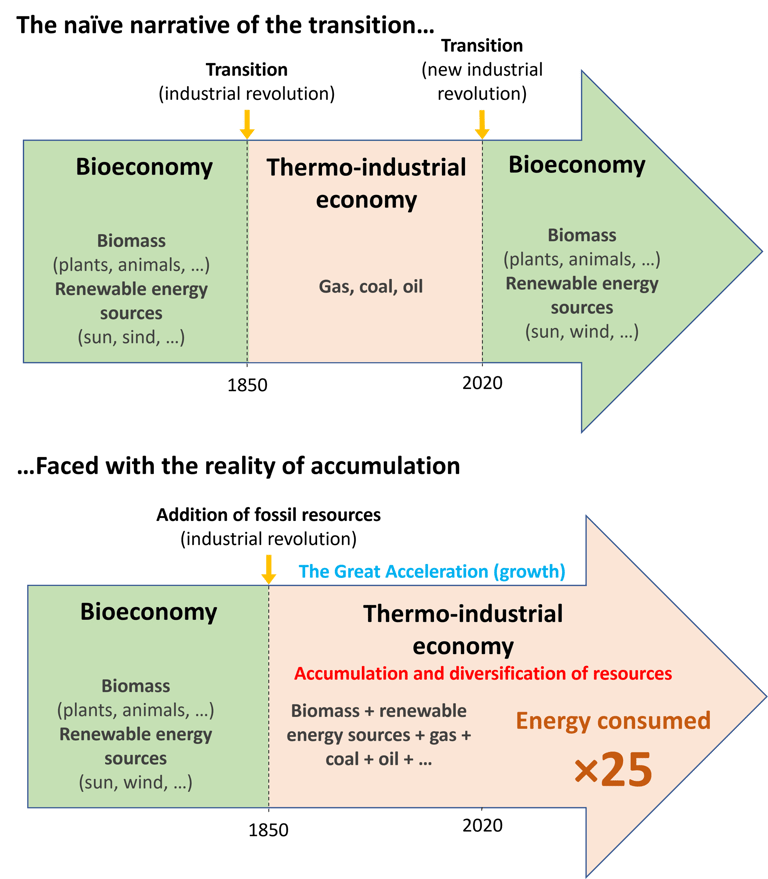
Figure 3: Diagram of the naïve transition narrative versus the reality of accumulation. The transition narrative suggests that fossil resources replaced biomass in economic processes, and that we now simply need to reverse this substitution in order to develop a bioeconomy. In reality, fossil resources were added on top of biomass; thanks to their extraordinary convenience, they also enabled the economy to expand to an almost unimaginable scale, which went hand in hand with a dramatic rise in energy consumption—roughly a twenty‑five‑fold increase between 1850 and 2024. Replacing fossil resources with biomass without an extraordinarily large reduction in the size of the economy therefore appears particularly challenging.
These two points (the accumulation of resources and the expansion of the economy) make the establishment of a bioeconomy within a context of economic growth—and even within a steady‑state economy—strictly IMPOSSIBLE. Let us recall that in France, the pre‑industrial bioeconomy based on wood and a ‘non‑fossilized’ agriculture led to a vast contraction of forested areas, even though resource and energy needs were incomparably lower than today (while the current population reaches 70 million inhabitants, it was then only around 10 million, living far more modestly).
Today, the term ‘bioeconomy’ in reality refers only to marginal segments of the global economy. These sectors, far from constituting an autonomous alternative, coexist with—or are deeply embedded within—the production chains of the thermo‑industrial system. For example, the ‘forest‑wood sector’, often presented as a major bioeconomic sector because it indeed relies on a direct product of photosynthesis, depends entirely on thermo‑industrial infrastructure: from logging machinery powered by fossil fuels to the transport and processing of wood, every stage relies on the resources and operational logic of the thermo‑industrial system.
Bio‑based products, often presented as ‘sustainable solutions’, are generally integrated into existing value chains without fundamentally altering their underlying logics or infrastructures. In other words, they are added to production flows still dominated by fossil resources rather than replacing them.
Take the example of biofuels. Their production has been rising rapidly [17]; however, because overall demand remains very high—and in some cases continues to grow—the consumption of fossil fuels does not decrease. In 2015, global biofuel consumption amounted to 144 Mtoe, representing 7% of total fuel consumption, which was still overwhelmingly dominated by diesel (847 Mtoe, 42%) and gasoline (1,035 Mtoe, 51%) [18]. In 2023, biofuel consumption reached 202 Mtoe, or 9% of global fuel consumption, which nonetheless remained largely dominated by diesel (906 Mtoe, 41%) and gasoline (1,104 Mtoe, 50%), whose consumption had even increased [19]. Biofuels do not substitute for fossil fuels; they complement them, following a logic of addition rather than substitution.
This dynamic reveals a central contradiction of the contemporary bioeconomy: under the guise of ecological transition, it perpetuates the extractivist structures of the thermo‑industrial system, greening them at the margins without ever questioning their foundations.
Ultimately, the conclusion is unequivocal: although it began as a revolutionary intellectual concept, the bioeconomy has been absorbed and emptied of its substance by progressivist thought, becoming a kind of conceptual aberration—far closer to the most abject form of greenwashing than to any meaningful response to contemporary challenges.
Notes
*Biomass (also referred to as “products of photosynthesis” or “bio‑based products”) designates the organic matter of living organisms, as opposed to the necromass of fossil resources, derived from the decomposition of organisms that died millions of years ago.
**Sobriety here essentially means efficiency—or rather efficacy—often summarized by the engineers’ famous maxim: “doing more with less”.
***Not to be confused with a subsistence economy, in which production is constrained and covers only the bare minimum—an idea often condescendingly projected onto pre‑industrial societies, as if they had merely subsisted. This is a highly caricatural generalization and simply false in most cases (see, for example, Graeber and Wengrow, The Dawn of Everything: A New History of Humanity, Allen Lane, 2021).
****A central postulate of “orthodox” economics, formulated two centuries ago by the French classical economist Jean‑Baptiste Say: “Natural resources are inexhaustible, for otherwise we would not obtain them for free. Since they can neither be multiplied nor exhausted, they are not the object of economic science”.
*****A delay in understanding that suggests orthodox economists are not exactly renowned for their sharpness or intellectual agility.
References
[1] Ministère de l’Agriculture, de l’Agro-alimentaire et de la Souveraineté alimentaire, « Qu’est-ce que la bioéconomie ? », agriculture.gouv.fr. 2019. https://agriculture.gouv.fr/quest-ce-que-la-bioeconomie
[2] Ministère de l’Agriculture, de l’Agro-alimentaire et de la Souveraineté alimentaire, « La bioéconomie, nouvelle vision du vivant », agriculture.gouv.fr. 2019. https://agriculture.gouv.fr/la-bioeconomie-nouvelle-vision-du-vivant
[3] N. Georgescu-Roegen, « The Entropy Law and the Economic Process », 1971.
[4] HuffPost, « Avant la présentation du plan, Macron donne sa définition de la sobriété », Le HuffPost. 2022. https://www.huffingtonpost.fr/france/video/macron-donne-sa-definition-de-la-sobriete-energetique_208639.html
[5] S. Mongeau, La simplicité volontaire. Écosociété, 2023. https://ecosociete.org/livres/la-simplicite-volontaire
[6] S. Latouche, Petit traité de la décroissance sereine. Mille et une nuits, 2007.
[7] N. Georgescu-Roegen, La Décroissance : Entropie, écologie, économie. Sang de la Terre, 1979.
[8] La Décroissance, « La décroissance est un art de vivre. La décroissance n°219 ». 2025. http://www.ladecroissance.net/?chemin=journal&numero=219
[9] European Commission, « A sustainable bioeconomy for Europe - strengthening the connection between economy, society and the environment : updated bioeconomy strategy | Knowledge for policy ». 2018. https://knowledge4policy.ec.europa.eu/publication/sustainable-bioeconomy-europe-strengthening-connection-between-economy-society_en
[10] European Commission, « EU Bioeconomy Monitoring System | Knowledge for policy ». https://knowledge4policy.ec.europa.eu/bioeconomy/monitoring_en
[11] Ministère de l’Agriculture, de l’Agro-alimentaire et de la Souveraineté alimentaire, « Une stratégie bioéconomie pour la France - Plan d’action 2018-2020 », agriculture.gouv.fr. 2018. https://agriculture.gouv.fr/une-strategie-bioeconomie-pour-la-france-plan-daction-2018-2020
[12] N. Béfort, P. Grouiez, R. Debref, et F.-D. Vivien, « Les récits de la bioéconomie comme grille de lecture des tensions sur les transformations écologiques du capitalisme », Revue de la régulation. Capitalisme, institutions, pouvoirs, no 35, 2023, doi: 10.4000/regulation.23106. https://journals.openedition.org/regulation/23106
[13] European Commission, « Innovating for Sustainable Growth: A Bioeconomy for Europe | European Committee of the Regions ». 2012. https://cor.europa.eu/en/our-work/opinions/cdr-1112-2012
[14] J. Perlin, A forest journey: The role of wood in the development of civilization. Harvard University Press, Cambridge, MA, 1991.
[15] Jean-Baptiste Fressoz, Trajectoire de nos sociétés. Académie des sciences. 2024. https://www.youtube.com/watch?v=PDftwPhO-zU
[16] H. Ritchie et P. Rosado, « Energy Mix », Our World in Data, 2020. https://ourworldindata.org/energy-mix
[17] Mordor Intelligence, « Analyse de la taille et de la part du marché du bioéthanol - Tendances de croissance et prévisions (2024-2029) », Mordor Intelligence. 2023. https://www.mordorintelligence.com/fr/industry-reports/bio-ethanol-market
[18] IFPEN, « Tableau de bord biocarburants 2017 », www.ifpenergiesnouvelles.fr. 2017 https://www.ifpenergiesnouvelles.fr/article/tableau-bord-biocarburants-2017
[19] IFPEN, « Tableau de bord biocarburants 2024 », www.ifpenergiesnouvelles.fr. 2023. https://www.ifpenergiesnouvelles.fr/article/tableau-bord-biocarburants-2024
Conclusion
Born in the 1960s–1970s under the impetus of Nicholas Georgescu‑Roegen, the original bioeconomy carried a radical ambition: to break with the dominant economic paradigm. It was not merely about substituting fossil resources with solar energy or the products of photosynthesis; it called for a profound transformation of production and consumption patterns, ways of life, and the philosophical foundations of our societies. In short, it envisioned a systemic revolution grounded in extreme frugality in the use of resources.
But by the early 2000s, the bioeconomy re‑emerged in a largely watered‑down form. Now presented as a ‘lever for optimizing bio‑resources’ through technology, it has been reframed within a logic of competitiveness and economic growth—an orientation in total contradiction with its founding principles.
Stripped of its vital core — radical frugality and an explicit embrace of degrowth — the contemporary bioeconomy resembles a football match without a ball: it has lost all meaning. What is today called a ‘bioeconomy’ is nothing more than a collection of economic segments that may indeed rely on biomass, but remain firmly anchored in the thermo‑industrial system, which they reinforce far more than they challenge.
A conception that was once coherent and revolutionary has thus morphed into an incoherent and harmless simulacrum, fit to join the museum of grotesque farces in growth‑and‑innovation ecology, where it can proudly sit alongside green growth, sustainable development, and the ecological transition.
This is not a call to reject the use of biomass in the economy. But out of respect for the intellectual legacy of the founder of the bioeconomy, we should refuse to use this term when the recourse to biomass primarily serves the interests of business and economic growth. Without degrowth and extreme frugality, the bioeconomy can only be a grotesque farce — or simply cannot be at all…
Henri Cuny