


Articles on the Anthropocene
In-depth articles on the Anthropocene
Is the ecological transition underway?
Anatomy of the great bluff of the transition in the kingdom of spin doctors
The ecological transition is said to be underway, driven in particular by electrification. Source: Pixabay, https://pixabay.com/photos/electricity-electricity-pylons-4666566/.
The recognition of the damage inflicted on nature by the thermo‑industrial economy has made the idea of a necessary ‘ecological transition’ unavoidable. And I have excellent news to share with you: this transition is said to be underway! France’s ministry dedicated to ecological issues since 1971 — and whose official title has explicitly included the term ‘ecological transition’ since 2017 [1] — now aims to ‘accelerate the ecological transition across all territories’ [2]. At the international level, the UN Secretary‑General, António Guterres, is issuing ‘a powerful call for an accelerated and equitable transition’ [3]. Everything therefore seems to be on track, and it would appear that all we need to do is speed up a movement already well underway… Still, it’s worth taking a closer look, just to make sure there’s no risk of derailment.
Where there’s ecological transition, there’s energy transition
To clearly delimit the topic, let’s begin by giving the definition of ecological transition, using the one provided by OXFAM:
“The ecological transition is a shift toward a new economic and social model that provides a comprehensive and lasting solution to the major environmental challenges of our century and to the threats weighing on our planet. Operating at every level, the ecological transition aims to establish a resilient and sustainable development model that rethinks the ways we consume, produce, work, and live together” [4].
An ambitious programme indeed! This definition reminds us that the ecological transition entails a profound and comprehensive transformation of our societies [5], not just a few ‘small gestures’ or minor adjustments. Let us, however, focus our attention on the question of energy, which lies at the heart of the matter.
Our economic model relies on massive use of fossil fuels, which generate considerable greenhouse‑gas emissions and drive climate change. It therefore seems obvious that any serious ecological transition must involve an energy transition.
This is precisely the aim of the ‘European Green Deal’, launched by the European Commission in 2019, which aspires to ‘transform the European Union into a modern, resource‑efficient and competitive economy’, notably through ‘a clean and efficient energy transition’ [6].
Similarly in France, the ‘Energy Transition for Green Growth Act’, adopted in 2015, seeks to ‘prepare for the post‑oil era and establish a robust and sustainable energy model capable of addressing energy‑supply challenges, price volatility, resource depletion and environmental‑protection imperatives’ [7].
António Guterres, Secretary‑General of the United Nations, is also resolutely optimistic about the energy transition: ‘Fossil fuels are nearing their end’ and ‘nothing can stop the energy transition’, even if it is ‘still neither fast enough nor fair enough’ [3]. Ursula von der Leyen, President of the European Commission, echoes this view, asserting that ‘the transition to clean energy is underway’ [8].
So, are we truly in the process of carrying out an ‘energy transition’, which would indeed be a clear sign of the much‑vaunted ‘ecological transition’?
The narrative of the energy transition
To carry out any activity, humanity can draw on a wide range of energy sources: wind, sunlight, wood, oil… The various sources used at a given moment make up the energy mix. Since a transition is the ‘passage from one state to another’ (Larousse definition; [9]), the energy transition therefore implies a gradual change in the composition of this mix: over time, some sources recede while others take their place.
The rhetoric underpinning the narrative of the energy transition is well known: throughout history, the energy mix has evolved, with certain sources replacing others thanks to technical discoveries or new resources. For example, before the Industrial Revolution, biomass—especially wood—was central, used for domestic heating or for activities such as metallurgy. Then came fossil resources, which gradually supplanted wood: coal became dominant in households and blast furnaces, ushering in a new energy era.
This narrative paves the way for the emergence of a new transition: one in which renewable energy sources (notably sun and wind) would in turn replace fossil resources in powering the economy, which would then become ‘decarbonised’ and ‘more respectful of living systems’.
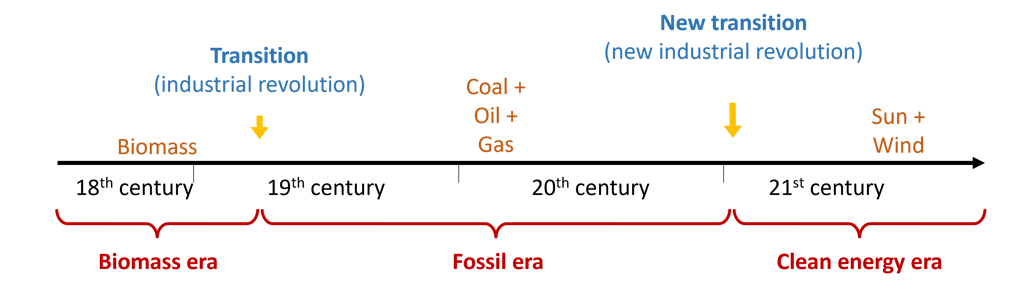
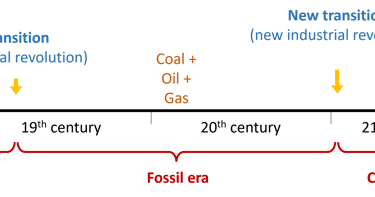
Figure 1: The model of the energy transition, showing the succession of different phases according to the energy sources used. Throughout history, humanity has relied on various energy sources, depending on technological advances and available natural resources. Before the Industrial Revolution, biomass was the primary source of energy. Coal, oil, and gas emerged in the 19th century and dominated until the early 21st century. More recently, so‑called ‘renewable’ energies have appeared, ushering in a new energy era.
The narrative of the energy transition even comes with its own figures and its own graph (Figure 2). Until the early 19th century, biomass accounted for almost all (more than 95%) of the global energy mix. From 1850 onward, coal entered the picture, followed by oil and gas. By 1900, coal made up 47% of the mix, while biomass had fallen to 50%. The share of fossil resources peaked in the second half of the 20th century (the 1970s–1980s), exceeding 80% of the energy mix (for example, in 1970: 15% gas, 40% coal, and 25% oil), while biomass dropped below 15%. At the beginning of the 21st century, another shift seemed to be taking shape, with the growing contribution of energy sources such as solar and wind, even though their share remains marginal (in 2024, solar energy represents 2.2% of the mix and wind energy 3.3%). Enough to suggest that we may be standing at the dawn of a new energy era?
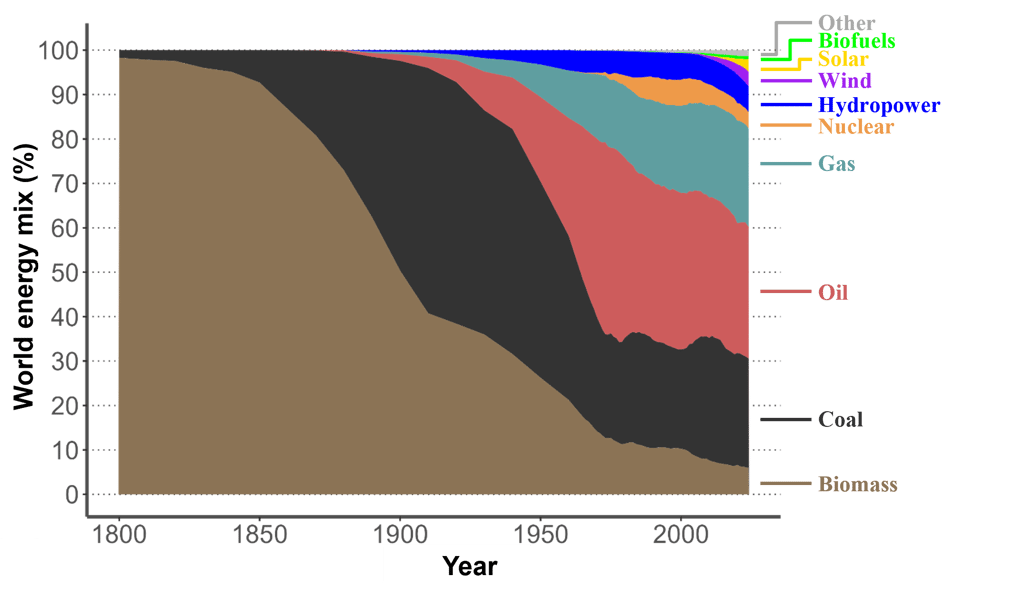
Figure 2: Evolution of the relative share of the global energy mix since 1800. The graph shows the share of each energy source in total consumption, expressed as a percentage. Before 1850, biomass (notably wood) was the primary source of energy. Fossil resources (first coal, then gas and oil) appeared thereafter and took on an increasingly important role in the energy mix, eventually dominating it from the early 20th century onward. They remain predominant today, but other sources began to grow from the late 20th century (nuclear, hydropower) and the early 21st century (solar, wind). Data source: Our World In Data (https://ourworldindata.org/energy-mix) [10]
The reality of energy accumulation
Analyzing the relative share of each energy source in the global energy mix is informative, but it obscures a fundamental dimension: the total amount of energy consumed. Representing the energy mix in absolute rather than relative values therefore tells a completely different story (Figure 3)! In this view, the history of energy no longer appears as a sequence of transitions and successive phases, but rather as a continuous stacking of energy sources over time and a phenomenal growth in total energy consumption, which has increased thirtyfold between 1800 and 2024.
Take the example of the rise of industrial coal exploitation in the 19th century: coal did not replace biomass—it was added to it. Certainly, it could substitute for wood in some processes (heating, metallurgy), but new uses for wood emerged (mine timbering, railway construction), illustrating an overall logic of accumulation rather than substitution.
Our new story of energy is therefore the following: before the 19th century, biomass was the primary source of energy for human activity. Over the course of the 19th century, coal, then gas and oil, were added to it. During the 20th century, new energy sources such as nuclear power and hydropower joined the mix, which was further enriched in the 21st century by various other sources (solar and wind energy, biofuels…).
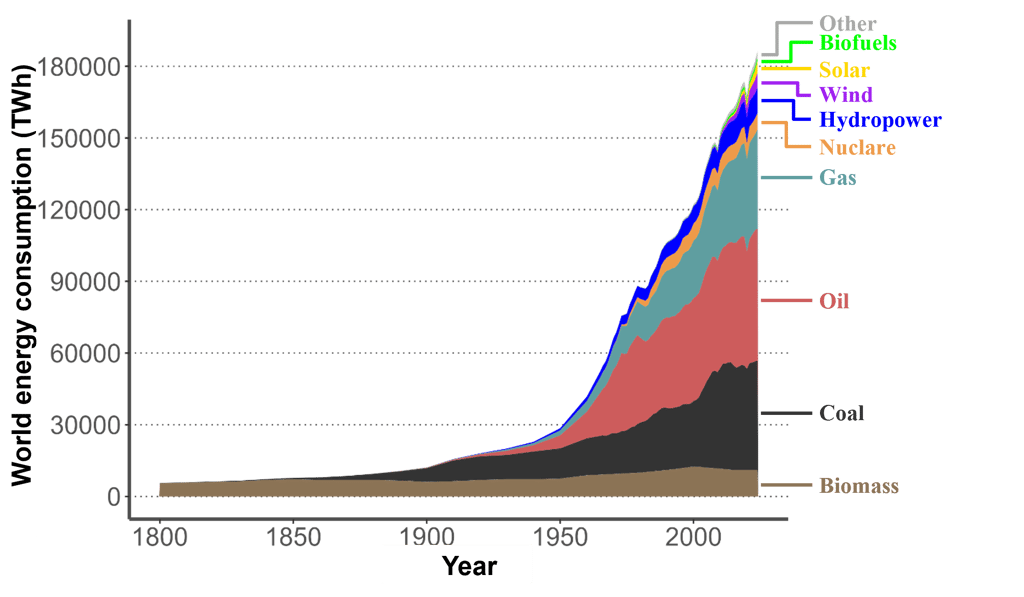
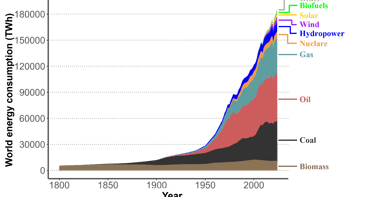
Figure 3: Absolute evolution of the global energy mix since 1800. The graph shows the absolute quantities of energy consumed by source. Before 1850, biomass (notably wood) was the primary source of energy. Fossil resources (first coal, then gas and oil) appeared thereafter and were added to biomass, driving a sharp increase in total consumption. Other sources were added from the late 20th century (nuclear, hydropower) and the early 21st century (solar and wind). Overall, the trends reveal a dynamic of energy accumulation, marked by a diversification of sources and an explosion in global consumption since the early 20th century, with fossil fuels remaining dominant. Data source: Our World In Data (https://ourworldindata.org/energy-mix) [10].
At the global level, we must therefore accept the fact that no sign of an energy transition is visible: there is a clear dynamic of energy accumulation, and the consumption of fossil resources has, in absolute terms, never been higher than it is today. We may thus allow ourselves to contradict António Guterres’s tall tale: judging by the numbers, the world of fossil fuels is not ‘running out of steam’ [3] but is, on the contrary, doing better than ever—thank you very much.
This observation also leads us to revise the energy transition model presented in Figure 1, which we will therefore replace with the model of energy accumulation (Figure 4):
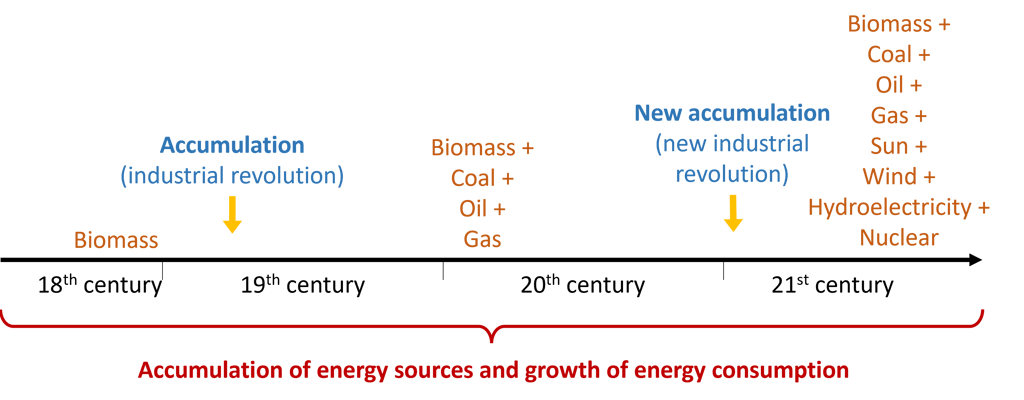
Figure 4: The model of energy accumulation, showing the addition of energy sources over time. Over the past few centuries, thermo‑industrial civilization has tended to stack energy sources as technological discoveries and natural resources have become available. To biomass, which was the primary source of energy before the Industrial Revolution, were added coal, oil, and gas during the 19th century, followed by new energy sources (sun, wind, nuclear…) in later periods. This diversification of energy sources goes hand in hand with a dramatic increase in energy consumption.
At the global level, the energy transition is therefore a fantasy—an hallucination entertained by addicts of innovation and green growth. But does this implacable global picture necessarily hold at a more local scale? In France, the ‘Energy Transition for Green Growth Act’ sets ambitious targets: ‘to reduce final energy consumption by 50% by 2050 compared with the 2012 baseline, with an intermediate target of 20% by 2030,’ while increasing ‘the share of renewable energies to 23% of gross final energy consumption by 2020 and to 32% by 2030’ [7].*
In 2012, national energy consumption reached 3,000 TWh [11]. By 2024, it had fallen to 2,500 TWh [12], a 16% decrease in 12 years. Not bad at all, then!
However, the easiest reductions were achieved first: limiting energy waste in public buildings, improving the energy efficiency of housing and certain industrial processes… The main driver of this decline is nonetheless economic, as the surge in energy prices in recent years has pushed households and businesses to reduce their consumption [13].
Further reductions will be more difficult to achieve, especially since neither the general orientations (commitment to economic growth, continued digitalization and deployment of AI, …) nor the prevailing lifestyle (consumerist) have fundamentally changed. The spectacular drop observed in recent years is a good start, but it does not guarantee that the targets will be met, and maintaining this downward trend in the medium term remains a colossal challenge [14].
Other targets are also off track: the share of renewable energies in the national mix was 15% in 2023 (versus a target of 23% in… 2020), while fossil sources still accounted for 45% (target: 30% in 2030) [12], and nuclear for 39%—and nearly 70% of electricity production (with a target of 50% in… 2025!) [15]. That said, nuclear has become fashionable again and ‘clean’ in official discourse, which in practice renders the objective of reducing the share of nuclear in the national mix obsolete [16].
Can Gargantua go on a diet?
France may well have acknowledged the need to reduce energy consumption in its policy objectives, but public discourse on the energy transition often obscures this quantitative dimension, focusing instead on the qualitative one—namely, which energy sources make up the energy mix. Yet if we accept that no energy source is truly ‘clean,’ then the question of how much energy is consumed becomes crucial. An insoluble dilemma of the energy transition then emerges: how can we consume less energy in a world whose driving force is economic growth—that is, the growth of human activity and, ultimately, of energy consumption?
Yes, a significant decline in energy consumption can indeed be observed in some countries such as France—that is, in countries historically very lavish with energy (the ‘rich’ or ‘developed’ countries), which can afford to trim the excess in the short term without too much difficulty, given how blatant the waste once was. But this local and temporary decline is occurring alongside a spectacular surge in energy consumption in many other countries, which are experiencing rapid economic growth as they attempt to ‘catch up’ with the fabulous productivist and consumerist model so long celebrated by Western nations. At the global level, we remain locked into a logic of energy inflation, and it is difficult to imagine a voluntary reduction in the short term.
There’s more to life than energy
To this day, the energy transition has no global reality, which already deals a serious blow to the very concept of ecological transition. Moreover, even though the question of which energy sources we use is crucial, it is by no means the only one that matters if the goal is to move toward a system that is less destructive to living beings.
To begin with, using energy sources other than coal, gas, or oil is in no way a guarantee of a more ecological system. Fossil resources have one undeniable advantage: their density. By contrast, capturing solar or wind energy requires extensive, sometimes invasive installations and complex logistics. While the sun and the wind are ‘clean’—and may lead António Guterres and many others to believe that ‘we are on the cusp of a clean‑energy age’—the systems used to capture these energy sources (photovoltaic panels and wind turbines) are far less so. One can certainly discuss the relative advantages and drawbacks of each energy source (and fossil fuels obviously have major drawbacks), but speaking of ‘clean energy’ undermines ecological discourse, ultimately harming ecology and contributing to its political self‑sabotage for decades.
Above all, the energy sources we use tell us nothing about the purpose of our activity. Is manufacturing cars, planes, ships, or—returning to a currently booming business—‘low‑carbon’ tanks and missiles really so important? Will ethical, sustainable, decarbonized nuclear bombs help us build a ‘more ecological’ civilization ‘closer to nature’?
Energy is only a means, not an end. As long as we use astronomical quantities of energy to artificialize land, manufacture machines of death, or produce harmful—or at best useless—objects, it is illusory to imagine transitioning toward a more ecological civilization, even if the energy comes from the sun or the wind. The central question of the ecological transition should therefore not be which energy source we use, but rather how much energy we use (cf. bioeconomics), and above all, what we use it for.
Do we still have time to carry out a transition?
Over time, a well‑oiled narrative around the ecological transition has taken hold: a transition driven both from the ‘top,’ through visionary policies laying out plans over several decades, and from the ‘bottom,’ through innovative actors (citizens, start‑ups, local authorities, such as the Transition Towns movement) working tirelessly to implement the transition on the ground—all of it unfolding within a gradual dynamic aimed at targets set for the middle or second half of the 21st century.
This narrative corresponds to a ‘gradualist’ approach (Simmens H., A Climate Vocabulary of the Future, 2017), based on a succession of small changes at every level, supposedly capable of transforming our society deeply and durably. ‘Like sustainable development, the transition assumes that such a social transformation can only be envisaged over several decades—the horizon of the second half of the 21st century is often mentioned.’ [5] The overall impression is that of a controlled movement, combining planning and popular support, and one that presupposes having time ahead of us. But do we still have time? After decades of being lectured about the transition, sustainable development, and green growth, what has actually happened? Greenhouse gas emissions and various other pollutants (plastics) have continued to rise, climate change and environmental degradation have worsened, and life has kept collapsing.
As shown above, ‘gradualism’ does not withstand the test of reality. It must therefore be stated plainly: there is (and will be) no energy or ecological transition, just as there is (and will be) no green growth, no sustainable development, or any other such chimera. It is urgent to abandon this soothing logic of gentle transformation, which peddles false promises and whose only real effect is to prolong a system that is fundamentally destructive. The task is no longer to ‘transition,’ but to overturn the table—to change profoundly, radically, and rapidly.
Notes
*A local transition would, of course, remain anecdotal in the context of a generalized ecological catastrophe, yet it would nonetheless constitute proof of feasibility—and therefore a sign of hope for broader implementation in the future.
References
[1] Wikipédia, « Ministère de l’Écologie (France) », Wikipédia. https://fr.wikipedia.org/w/index.php?title=Minist%C3%A8re_de_l%27%C3%89cologie_(France)&oldid=233639467
[2] Ministères transition écologique, aménagement du territoire, transports, ville et logement, « Fonds vert : accélérer la transition écologique dans les territoires ». 2023. https://www.ecologie.gouv.fr/fonds-vert
[3] Nations Unies, « L’énergie fossile est morte. Vive l’énergie renouvelable ! », ONU Info, 2025. https://news.un.org/fr/story/2025/07/1157166
[4] Oxfam France, « Transition écologique : définition et moyens d’actions », Oxfam France, 2022. https://www.oxfamfrance.org/climat-et-energie/transition-ecologique/
[5] A. Boutaud et N. Gondran, « 14. Est-il trop tard pour la transition ? Le temps de l’urgence climatique », Regards croisés sur l’économie, vol. 26, no 1, p. 215‑225, 2020. https://shs.cairn.info/revue-regards-croises-sur-l-economie-2020-1-page-215?lang=fr
[6] « The European Green Deal - European Commission ». https://commission.europa.eu/strategy-and-policy/priorities-2019-2024/european-green-deal_en
[7] Ministères transition écologique, aménagement du territoire, transports, ville et logement, « Loi de transition énergétique pour la croissance verte ». 2016. https://www.ecologie.gouv.fr/politiques-publiques/loi-transition-energetique-croissance-verte
[8] Commission européenne, « Discours de la présidente von der Leyen lors du sommet des Nations unies sur le climat 2025 », Représentation en France, 2025. https://france.representation.ec.europa.eu/informations/discours-de-la-presidente-von-der-leyen-lors-du-sommet-des-nations-unies-sur-le-climat-2025-2025-09-25_fr
[9] É. Larousse, « Définitions : transition - Dictionnaire de français Larousse ». https://www.larousse.fr/dictionnaires/francais/transition/79157
[10] H. Ritchie et P. Rosado, « Energy Mix », Our World in Data, 2020. https://ourworldindata.org/energy-mix
[11] Commisariat général au développement durable, « Le bilan énergétique de la France en 2012 : une consommation en baisse sous l’effet de la morosité économique », Le point sur, no 168, 2013. https://www.statistiques.developpement-durable.gouv.fr/sites/default/files/2018-10/lps-168-bilan-energie-de-la-france-en-2012.pdf
[12] Commissariat général au développement durable, « Chiffres clés de l’énergie - Édition 2025 », 2025. https://www.statistiques.developpement-durable.gouv.fr/edition-numerique/2025/chiffres-cles-energie/fr/
[13] D. M. Alsdorf, « Baromètre 2025 de l’énergie : les Français consomment moins mais paient plus cher », LeLynx.fr, 2025. https://www.lelynx.fr/a-propos/communiques/barometre-2025-energie/
[14] « La consommation d’énergie en France : une baisse confirmée », La Revue des Transitions, 2024. https://larevuedestransitions.fr/2024/12/19/la-consommation-denergie-en-france-une-baisse-confirmee/
[15] EDF, « Le nucléaire en chiffres - Comprendre l’énergie | EDF ». EDF, 2025. https://www.edf.fr/groupe-edf/comprendre/production/nucleaire/nucleaire-en-chiffres
[16] Macron, « Sommet sur l’énergie nucléaire », elysee.frn 2024. https://www.elysee.fr/emmanuel-macron/2024/03/21/sommet-sur-lenergie-nucleaire
Conclusion
The ecological transition that politicians, the media, scientists, and others have been drumming into our ears for decades is a chimera. It shows no tangible reality at the global scale, even when the analysis is restricted to the energy sector. The trends of recent decades reveal a world of accumulation far more than a world in transition.
The real question, then, concerns the model within which the ecological transition is supposed to take place—namely, economic growth, which presupposes a ‘more and more’ logic that inevitably generates accumulation. An ecological transition in a world whose leitmotif is economic growth is a bit like trying to change one’s diet while making drunkenness a way of life: a senseless exercise, doomed to failure.
The essential point revealed by this failure is that a genuine transition is not primarily a qualitative matter (which energy sources or materials are used) but a quantitative one (how much energy and how many resources are consumed). In other words, it is less a matter of means than of ends (growth, accumulation). Which means that those who speak of ‘clean energy’ or ‘ecological transition’ while deliberately omitting the quantitative dimension are taking you for fools.
The ecological transition joins the long litany of hollow, interchangeable, substance‑less concepts that eventually run out of steam, only to be replaced by another. Sustainable development is dead? Long live green growth! Green growth is dead? Long live the ecological transition! And tomorrow? Long live sustainable growth, sober development, frugal growth, ecological development… Pick your favorite jargon and submit it to the Ministry for Ecological Transition.
Henri Cuny